
Too hard basket #3
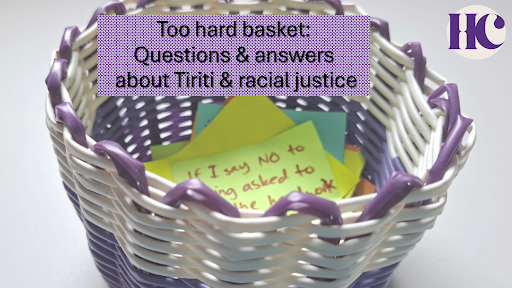
One of the devices Heather Came & Associates use in the classroom is the Too Hard Basket - as featured in E-tangata. We use it has a mechanism to co-create curriculum. The questions are collected at the beginning of class and answered by a panel in the afternoon. The questions are often honest, thoughtful and brave. With the permission of our students, here are some of the questions and some attempts at answers in case they are useful.
What would have to happen for the Waitangi Tribunal to be no longer needed?
The Waitangi Tribunal exists because the New Zealand government continues to breach Te Tiriti responsibilities and perpetrates structural harm against tangata whenua. For the Tribunal to become redundant, the Crown needs to fulfil its Tiriti responsibilities. At a macro level this requires constitutional transformation to reflect that Māori have never ceded sovereignty. This means moving beyond a system where Pākehā hold disproportional influence on governance and implementing power-sharing frameworks, such as those articulated in Matike Mai Aotearoa. Practically, to uphold Te Tiriti demands the restoration and return of confiscated land, constitutional recognition of tikanga Māori, and the elimination of institutional racism across domains such as health, justice, education, and welfare. Until tangata whenua hold full authority over their own lives, resources, and futures, and until state systems are restructured to guarantee Tiriti justice, the Tribunal remains an essential tool for accountability. It will only become unnecessary when the Crown stops violating the terms that legitimate its very presence here.
"True or false? Māori have benefitted from Colonisation..."
False. Plain and simple. Arguing that Māori have benefitted from colonisation is a form of colonial gaslighting designed to obscure historical violence and ongoing dispossession. Prior to colonisation, tangata whenua possessed thriving economies, sophisticated health systems, and complex governance structures. What colonisation brought was massive land alienation, forced language suppression, deliberate destruction of economic bases, intergenerational trauma, and introduced disease. The roads, technology, and modern infrastructure people point to were not benevolent gifts; they were built on the capital of stolen indigenous land and designed to service a settler economy. Framing the survival and resilience of Māori within an oppressive system as a benefit excuses sustained State violence. Modern inequities in health, life expectancy, and imprisonment are the intended, structural outcomes of colonial project.
Do all cultures have a voice?
No, but they should have. In Aotearoa, institutional architecture remains overwhelmingly monocultural, centred on Pākehā priorities, Eurocentric values, and the dominance of English language. Claiming that all cultures have a voice ignores the realities of structural power and racial privilege. While multicultural diversity is frequently celebrated through food and cultural festivals, actual decision-making authority rests firmly within Westminster systems designed by and for a White settler majority. Minority, so called “ethnic” voices are routinely silenced, tokenised, or required to assimilate into dominant Western frameworks just to be heard. Furthermore, diminishing tangata whenua into one of many cultural voices intentionally erases Indigenous rights. Until public institutions dismantle White-centric monocultural practice and redistribute power, the idea that all cultures have an equal voice remains a comforting myth for those who hold the microphone.
After attending Tiriti training I felt guilty and depressed that my ancestors took part in receiving land for farming in the early days of NZ therefore causing distress to Maori people. How do I settle this in my spirit?
Guilt and depression are understandable initial reactions to (un)learning colonial history, but left unexamined, they become Pākehā paralysis - dead ends that centre Pākehā feelings over Indigenous justice. I believe you settle your spirit by shifting from guilt to engaging in decolonisation. If your ancestors directly benefitted from the unearned privilege of stolen land, and some of us inherit that legacy today; sitting in personal shame does nothing to dismantle ongoing harm. Consider shifting your focus toward active redress. Perhaps educate yourself and your family about local land wars and systemic racism. Support kaupapa Māori initiatives, consider returning land, and donating time and/or resources to indigenous-led causes. Use your position to disrupt institutional racism within your workplace, school, and social circles. Rangimarie - peace does not come from absolving yourself of history or feeling bad; it comes from doing the work to undo inherited privilege and becoming an effective ally for decolonisation.
Why do we look at systemic inequities for Pacific people when they are not Indigenous to New Zealand?
Looking at systemic inequities for Pacific communities is a matter of State accountability, human rights compliance, and racial justice. Aotearoa has a specific, documented history of exploitation across the Pacific, from colonial administration in Niue, and the Cook Islands to the violence of the Dawn Raids. The New Zealand government actively invited Pacific peoples here to build its post-war economy, yet structurally marginalised them in housing, health, and justice systems. Institutional racism does not discriminate based on whether a group holds indigenous status; it functions to maintain dominant Pākehā power. Pacific peoples experience sharp health disparities and socioeconomic barriers directly engineered by historical and contemporary policy. Addressing these inequities is an absolute obligation owed by the state to rectify ongoing institutional harms.


Comments